
Dance safety and comfort
The problem
Dancing has a scale, a ruler 📏 with two ends. One side 🟥 is dance as kinesthetic and emotional sharing — the pleasure of hugs and touch. Another one 🟦 is dance as a sportive and musical activity that uses physical connections only as a means of communication.

The problem arises when dancers have different positions of comfort on this scale. While making a dance less emotional and touchy could only lead to slight discomfort, pushing the limits to the other end could be perceived as sexual assault, which is totally unacceptable.
The core problem is that dance communities don't have rules clearly defined. No communication or safety protocols are established. Instead, they leave it to usual life skills, which are not very useful or are sometimes inapplicable in dances.
Even people with absolutely good intentions can face these issues if there are no clear rules.
The same lack of clarity helps those who come to dances with bad or egoistic intentions to succeed in harassing someone and have no negative consequences. Special attention is needed to protect newcomers from that behaviour.
Another point to work on is global awareness that this problem exists, that boundary violations occur frequently and produce a strong negative effect on all members of the community.
The tasks
We need to break the taboos of speaking directly about the things we don't like. We need to make the rules transparent. We need to teach people to communicate. We need to establish protocols for comfort and safety.
Mostly we all want our partners to enjoy the dance and avoid anything that disrupts the mutual joy.
But some dancers are beginners who don't know the rules. Some experienced dancers come with backgrounds in different dance styles that are based on different sides 🟥📏🟦 of the scale. And there's always plenty of room for mistakes and misunderstandings.
So the first task is to set the comfort-zone bounds softly for those who are willing to respect them — and to learn how to clarify and respect such bounds. This is both about talking and listening, declaring and accepting.
Unfortunately, sometimes dancers do not respect the bounds, physical or mental. That's the second task: how to recognize that things are not correct, how to act in these situations, and how to protect yourself. There can be many degrees here.
The third task is about how to deal with those who disrespect the rules and bounds intentionally and repeatedly. This case is more rare, but very harmful. Both dancers and communities need to know how to deal with them properly. The community should take special care to protect beginners and newcomers from that.
The Practical Guide
Most important: safety zone (red zone)
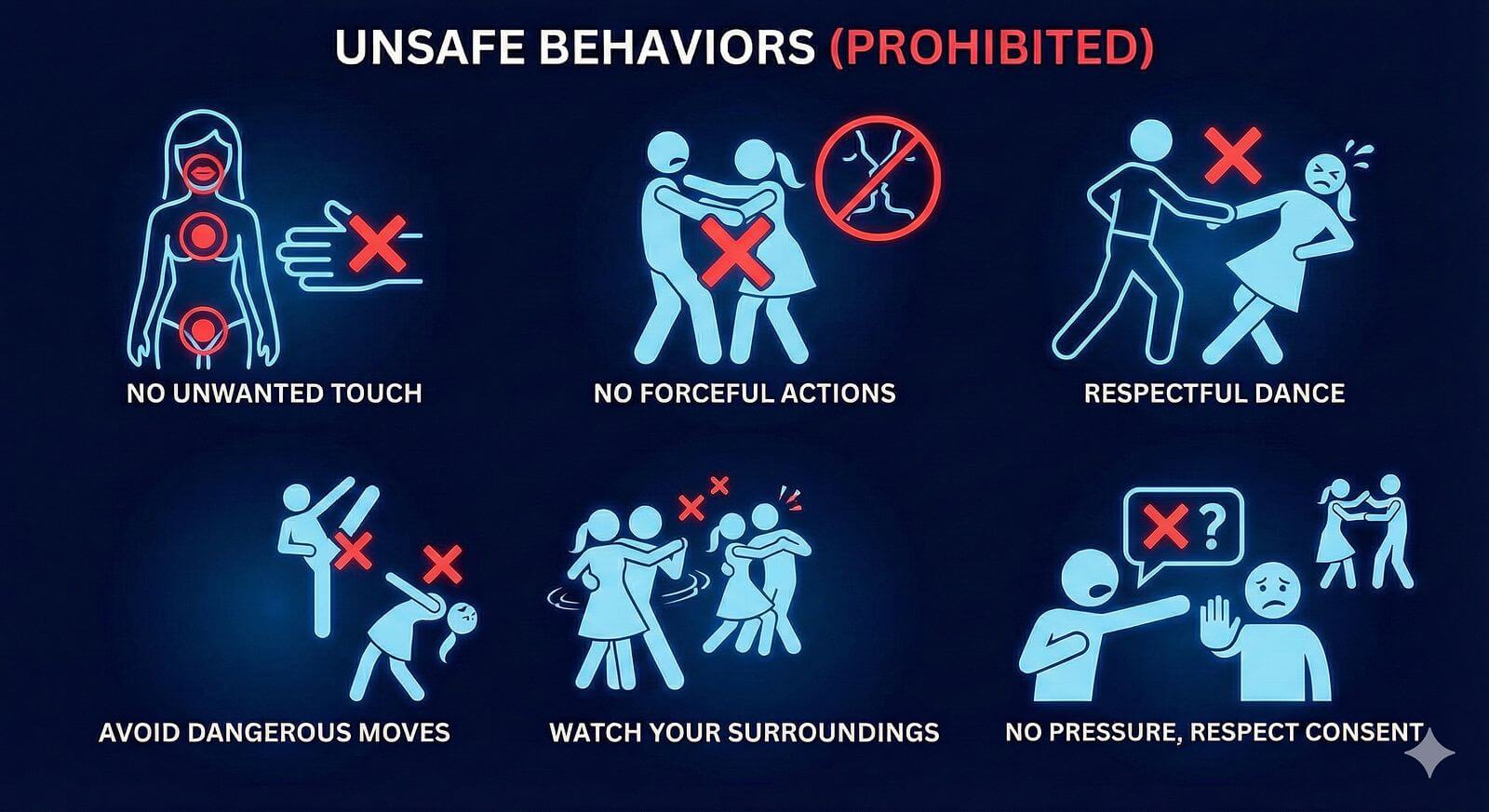
The core of the comfort zone is the area of safety. It consists of rules that are strict and common. What should be considered a big red flag, a "blocker":
-
touching primary intimate areas: lips, breasts, ass, and genitals
-
sexually intended actions carried out in a forceful or non-consensual manner, like pressing bodies into each other, rubbing body-to-body, or kissing
-
rude leading or rude following that potentially lead to physical harm or pain
-
dangerous moves that potentially lead to physical harm: locked joints, forced bends, legs lifted higher than waist level, head positioned lower than waist level
-
lack of attention to surrounding couples that leads to repeated collisions
-
abuse of freedom of choice: emotional pressure or psychological manipulations regarding accepting or refusing a dance invitation, insisting, hijacking someone's dance, etc.
If any of these things happen, that should ring a bell 🔔. If they happen repeatedly or several at once, that should trigger the alert 🚨!
If you are subject to any of these during a dance, say so directly. This can be hard to do, but we really need to learn to make things clear. Don't hesitate a second — say directly: "Please don't do this, it makes me feel uncomfortable." That's normal and should be respected.
If that doesn't help the first time, leave the dance immediately. You don't need to excuse yourself, but if you feel more comfortable doing so, just say "Thank you for the dance, but I need to stop now — I don't feel comfortable." Then stop and leave; don't continue this dance even if it's the middle of the song or a sequence. No one needs you to suffer.
Later you can think and decide whether it was the correct decision or not. It is advised to discuss any such cases with your friends and party organisers.
If you feel you were wrong, you can always apologise verbally or just invite this person yourself. Your safety is primary.
Red zone actions are restricted by default — no additional statements needed.
A special note for those who may think they could do some of these anyway
…because this partner is not against it (or you think so), because you really know each other well… Better not do it anyway.
-
You could be wrong about your partner in a moment; that happens far too often.
-
Your partner could accept in the moment but regret it later.
-
Other couples around may not feel comfortable seeing it.
-
Other couples may be inclined to copy it.
Passion can be great, but only up to a limit. You should control it, at least while on the dance floor.
Please also be aware that deep and profound connection can often be mistaken for a sign of love or sexual desire. This is wrong, and it should be well understood from the very beginning.
And keep in mind these safety basics:
No one is obliged to dance with anyone. No one is obliged to dance in an uncomfortable manner. There's no obligation to dance to the end of the song if something is wrong.
Comfort zone (grey zone)
Comfort is very important; we come to dances to relax and enjoy.

The following points are not blockers if carried out properly. Sometimes they are absolutely fine, but sometimes they can cause slight to severe discomfort. They include:
From the leader's side:
-
Drops
-
Lifts
-
Too many turns
-
Articulated touching of hips, neck, face, hair
-
Body contact (no distance)
From the follower's side:
-
Drops/jumps with weight on the partner
-
Unexpectedly fast turns
-
Going off-balance
-
Change of role
-
Solo dancing
Common for both:
-
Excessively strong smells: sweat, tobacco, alcohol, food, overly strong perfumes, aerosolised deodorants...
-
Excessive sweat
-
Wet clothes
-
Persistent invitations
The dancers should be informed that actions in this list are considered a "grey zone."
That means that if you do something from that list, do it with special attention to your partner: try to read their reaction and understand whether you should continue or avoid it. Generally, it's a good habit to ask if in doubt.
Actions in the grey zone are not restricted by default, but should be done with extra caution and attention to the partner's reactions.
A note on smells and sweat
If you are in doubt about your own condition, such as smell or sweat, it's always better to ask your friend, party organisers, or a person you trust. Hygiene is important.
Communications made clear
A clear "yes" is yes; everything else is "no."
If you are not sure you have a clear "yes" as the answer, you'd better clarify it verbally: "Is it OK if I lead instead of follow, lift you, or touch your shoulder?" And if there's no clear "yes", it should be treated as a strict "no."
Verbal communication is always better than non-verbal.
Non-verbal communication is helpful, but it requires both partners to speak this language. A lot of misunderstandings happen because people can't express their feelings reasonably, or because they read non-verbal reactions incorrectly or ignore them.
What helps to understand unspoken signals:
-
Pay attention to the reaction to the things you do, especially if they are in the grey zone.
-
Any change of behaviour could be a signal: a change in connection heaviness, sensible resistance to some actions, or an absence of reaction when one is expected (freezing).
-
In case of any doubts, ask verbally and confirm.
-
Seek a positive reaction; if you don't have a clear "yes", it means "no."
It's better to confirm any doubtful cases verbally.
Anything that is not understood when you try to transfer it non-verbally should be clarified with words.
It's necessary to learn to use our arms and legs to dance. It's equally necessary to learn to use our mouths to communicate. Telepathy often fails — use words!
Set the rules beforehand
It is absolutely great if you can confirm your primary ruleset before dancing starts.
If you know that you feel uncomfortable with something in the grey zone, or have personal limits — permanent or temporary, global or personal — it's better to have them announced beforehand.
For example, it's nice to say when you are inviting or being invited: "I don't like drops — is that OK?" or "Are you OK if we switch roles while dancing?"
Remember, in a grey zone the edges of rules are blurred. Which distance is considered too close? Could you touch the naked shoulder or better not? Are drops totally excluded or is some level acceptable, but deeper — not? Those are all subjects for dialogue.
It should not be only the responsibility of a leader, making the dance a game of guessing. It should not be only the responsibility of the follower, making the dance a game of manoeuvring. Both will benefit from rules set clearly.
At the same time, you need to be prepared that the person could decline to dance under these rules and the dance will not happen. In this case, take that refusal with gratitude as it saved you both from something unpleasant.
The art of saying "no"
The comfort zone can include many specific rules, like limits on movements, for many different reasons.
It is really good for dancers to inform their partner if they become uncomfortable with something during the dance. We can't predict everything that could happen, and we don't want to exchange long lists of rules and exclusions before each dance!
So if you need to say "no" to something, set some necessary rules right during the dance. Just do it softly and with respect to your partner: "Could we avoid drops, please?" or "Sorry, I don't like changing roles."
This is a polite way to say the things we're not comfortable saying or hearing. "Sorry, but no — I have a very sensitive sense of smell; I can't accept a dance while you're in a wet t-shirt."
Same with refusing invitations: it can be kind but firm: "Thank you, but no," without any explanations. Or "Thank you, not this time, but maybe later," if you just need to skip that one time.
Refusal can be polite and healthy or toxic and harmful. The same applies to setting boundaries. Be gentle, but don't let others violate your comfort zone. Never keep suffering!
Preferences are not rules
At the same time, we don't want the dances to become rigid and full of laws and rules.
Some choices should not be rules but preferences that can be adjusted or be subject to compromise. You need to understand for yourself what blocks you from dancing, what makes you suffer, and what is acceptable.
Sometimes it can be fun and joyful to try something out of your grey zone. Many good things can be discovered with a trial-and-error method. But if you tried and didn't like the result, don't hesitate to inform your partner about it.
There are many more things we might prefer or dislike: musicality, style, show-off, mood, energy, or whatever else. Such mismatches can also cause discomfort, but they're not usually dangerous.
Generally the rules are the same: don't suffer in silence; if you don't like something — say it clearly. In case your dance styles don't match, just don't accept another dance.
We usually try to avoid making too many adjustments and trying not to be "snowflakes." Some things can be simply fixed just by focusing on something else.
But again, no one is obliged to dance with anyone. If your preferences don't match and it's a "blocker" for you, find another partner to dance with.
Trust is a good base
All good dances on some level are built on trust in each other: fast moves, complicated figures, counter-balances... And we trust that people come to dances with good intentions. Most of them do!
Let's always start with trust, not the contrary. We don't need to be constantly on alert, and it's not a good idea to start dances by being suspicious and restrictive. This behaviour is also quite toxic.
Instead, know your boundaries and define them clearly if needed.
What should really ring a bell:
-
Safety zone violations, especially if repeated more than once. Mistakes happen, but repetitions are not mistakes.
-
Grey zone violations, especially if the bounds were set clearly and are being ignored.
Some moves and figures can require connections or touches that you personally don't expect to happen.
If they're not in the red zone, you may give them a chance and try to understand if they are required technically or are elements of style.
Some "grey zone" actions can look like violations at first, but later you may see they don't have any sexual context to be avoided. Conversely, some absolutely regular moves, like a touch of the hands, can be done in a very nasty manner.
If they bother you or you're in doubt, don't suffer:
-
ask for intentions to be made clear
-
ask to avoid them if needed; set the rules
-
if your rules are ignored, stop dancing
Until that really happens, let's have only good expectations.
Dances are unique
Each dance is unique. Rules can change from dance to dance together with the mood, the song, physical state, or just the fact that you are being observed or not.
What was allowed with another partner may not be allowed with you, and vice versa. What was good for one song may not be good for another.
Same applies to setting the rules: no one can keep in mind each partner's ruleset. Take it easy and remind if needed.
Different partners do the same moves differently. What you didn't like with one could be surprisingly good with another.
It's nice to adjust ourselves to our partners each time we start dancing.
Conclusion
Consent is about normalising the establishment of boundaries, saying "no" and accepting "no" from others. That makes dancing relations healthier, helping to avoid hidden tensions and unnecessary suffering.
It covers unwanted intimacy, physical harm, emotional violations of freedom of choice, and other rule mismatches.
It applies to both the leader and the follower equally, and requires attention and effort from both sides to be effective.
The consent framework only works if both partners use it properly. It will not work if one party doesn't know or doesn't consider it. It is not, and cannot be, a guarantee of protection.
At the same time, as with any other restrictions, we should be very careful. Incorrect use or excessive restrictions may ruin the amazing basics of dancing: freedom, mix of styles, expressiveness, trust.
For event organisers
The problems can be divided into two different types:
-
miscommunication issues, from both sides
-
intentional violations of rules and boundaries
These cases need different approaches to be handled properly.
The following measures could help to fix miscommunication issues:
-
your version of such a Guide should be available online, with a link added to each event announcement, so guests can read it beforehand
-
it’s great to have free workshops based on this Practical Guide or similar materials
-
make short introductions with references to the Guide at the beginning and in the middle of the party
We can't force everyone to read the guide, but keeping this information just one click away would help.
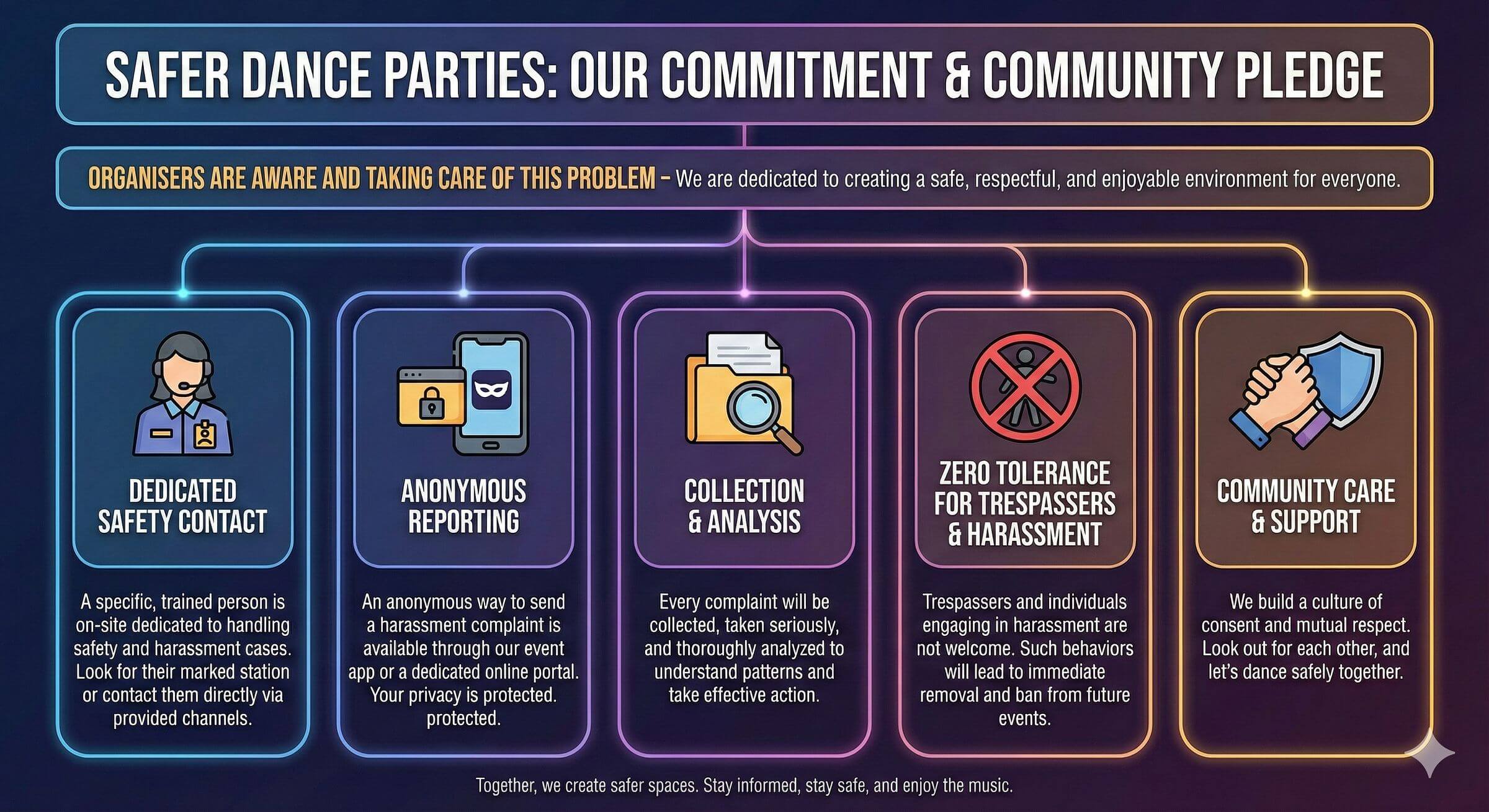
To handle situations involving people who intentionally refuse to learn or don’t care about their partners’ safety and comfort, the following measures could be announced:
-
inform guests that organisers are aware of the problem and are taking care of it
-
provide a specific person dedicated to handling these cases
-
provide an anonymous way to send a harassment complaint
-
inform guests that every complaint will be collected and analysed
-
inform guests that violators are not welcome, and repeated complaints will lead to a ban
If someone receives a single complaint, organisers should contact and warn that person, also requiring them to read the guide. If there are multiple complaints, a ban should be issued: from temporary to permanent.
All cases should be analysed by an experienced team and community members to protect the community from false complaints. It is important for every framework like this to include protection from self-abuse of the system.
The community should be informed that both warnings and bans are being issued — in depersonalised form — whenever incidents occur.
Short summary for "too long; didn't read"
-
Consent is a mutual responsibility of both partners. Don't put all the load only on the leader or only on the follower.
-
Learn what the red zone and the grey zone are. They should be treated differently.
-
Make things clear. There should be no place for the game of guessing. Prefer verbal communication over non-verbal.
-
Decide for yourself what are absolutely no-go "blockers" for you and inform your partner about them, preferably before the dance. Usually there are not many.
-
Some things are not blocking, but better be avoided. Like "I could stand it once, but please don't repeat." Mistakes and misunderstandings also happen. Learn how to deal with such cases.
-
Be kind and polite; don't be toxic when setting rules, saying "no" or accepting "no" from others. But never confuse politeness with weakness. Protect your boundaries firmly.
-
It's great if after setting your bounds you ask your partner if they have some own preferences.
-
Never insist, never force, never be persistent. Respect the freedom of choice.
-
Too many restrictions make the dance rigid; dancing in armour is safe but not joyful. Trust is always the basis for the best dances.
If you find this text useful, please share it with your friends and communities. It could be especially useful for beginners, but I hope that experienced dancers and teachers may also find something for themselves.
If you copy the text, please keep this signature:
2025, Mike aka Sir Dancelot, https://sir-dancelot.com
